
The northern lights are one of the most visible, and perhaps most breathtaking, results of the interaction between the Sun and Earth. They are created by a chain of events involving the Sun, Earth’s magnetic field and gases in the upper atmosphere. But how does this chain of events produce the northern lights?
In this article, we explain step by step what causes the northern lights and how their light is produced. We also look at what makes them move, where their different colors come from and what conditions are needed to see them from the ground.
- Summary: what causes the northern lights to appear?
- How do the northern lights form?
- What makes the northern lights move and grow brighter?
- Why can’t we see the northern lights every night?
- Why do the northern lights have different colors?
- Common questions about what causes the northern lights
- Would you like to see the northern lights for yourself? Join us on an aurora tour!
- Sources
Summary: what causes the northern lights to appear?
The energy behind the northern lights comes from the Sun, which constantly sends particles into space. This flow is called the solar wind. When the solar wind meets Earth’s magnetic field, some of its energy accelerates particles in the space around Earth and sends them toward the atmosphere. There, they collide with gases such as oxygen and nitrogen and produce light. We see this light as the northern lights. Earth’s magnetic field guides the particles especially toward the polar regions, which is why auroras are most often seen there.
How do the northern lights form?
The northern lights do not appear in the sky by chance. NASA explains their origin like this:
“When energetic particles from space collide with atoms and molecules in the atmosphere, they can cause the colorful glow that we call auroras.”
The collision is only the final stage of a longer process. Before that happens, energy travels from the Sun into the space around Earth, where particles interact with magnetic fields.
Here is a closer look at how the northern lights form and when they become visible from the ground.
1. The energy comes from the Sun
The Sun constantly releases electrically charged particles into space, mainly electrons and protons. This stream of particles is called the solar wind. It carries energy and a magnetic field that can affect the space around Earth.
The solar wind is always present, so a major solar eruption is not required for auroras to occur. When the solar wind becomes stronger, however, it can bring more energy toward Earth and produce brighter northern lights.
2. The solar wind meets Earth’s magnetic field
Earth is surrounded by a magnetic field that protects the planet from most of the particles carried by the solar wind. It does not stop every particle from getting through. When the magnetic field carried by the solar wind meets Earth’s magnetic field in the right way, some of its energy can enter Earth’s magnetosphere.
3. Particles collide with gases in the atmosphere, producing light
As electrons guided by Earth’s magnetic field rush into the upper atmosphere, they collide with oxygen atoms and nitrogen molecules. These collisions give the gas particles extra energy and briefly put them into an excited state. When the particles return to their normal state, they release that energy as photons, or particles of light.
A single collision produces only a tiny amount of light. But countless collisions taking place at the same time create the glow that we see across the sky. The Finnish Meteorological Institute compares the process to a fluorescent tube, where electricity causes gas to produce light.
4. The northern lights become visible from the ground
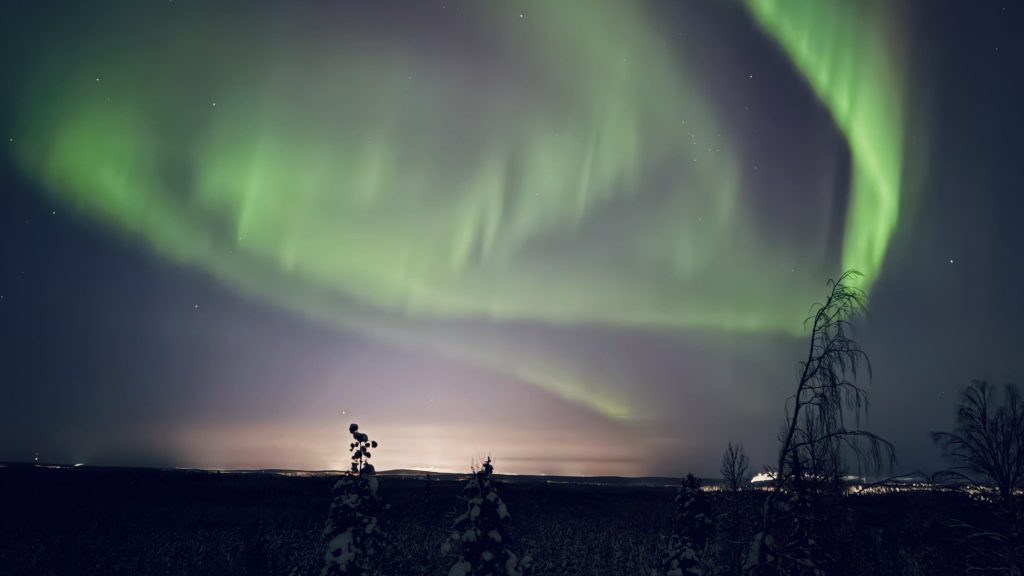
The light from the northern lights forms high in the upper atmosphere, but under the right conditions it can be seen from the ground. Auroras may appear as arcs, rays or slowly moving curtains of light.
For the northern lights to be visible to the human eye, the viewing conditions also need to be suitable. As we explain in an earlier article:
“To see the northern lights with the naked eye from the ground, you need a clear, cloudless sky. For example, clouds moving over your viewing location can completely block the aurora borealis from view, even if they are still present above the clouds.”
What makes the northern lights move and grow brighter?
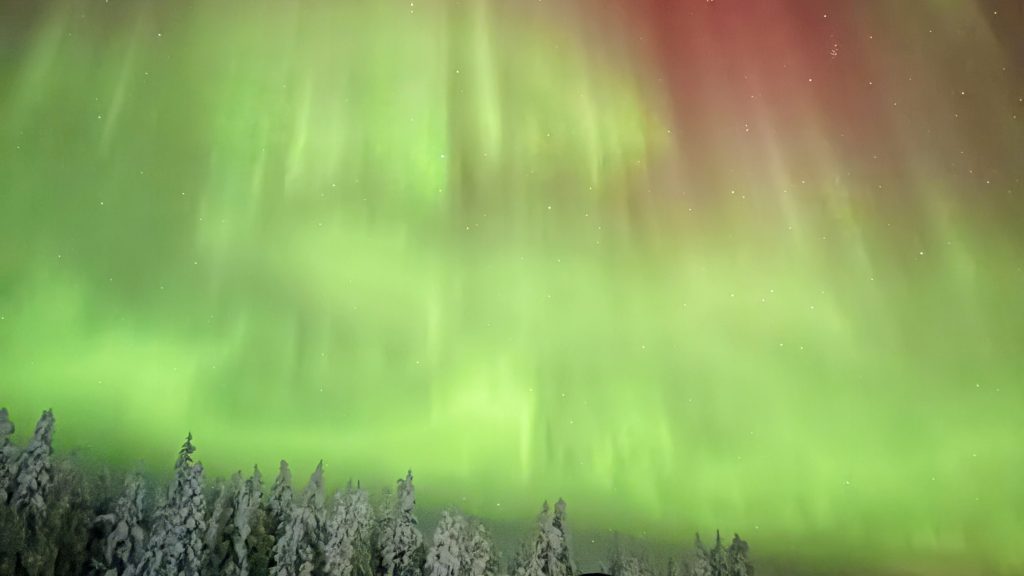
The movement of the northern lights is linked to changes in Earth’s magnetosphere and the flow of particles entering the atmosphere. As the electrons’ paths and energy levels change, so do the location and brightness of the auroral light. Energy stored in Earth’s magnetosphere can be released rapidly during an auroral storm. When this happens, a quiet arc can brighten, expand and begin moving quickly across the sky. Changes in the aurora’s brightness are also linked to vibrations in Earth’s magnetic field.
Why can’t we see the northern lights every night?
Auroras can occur even when you cannot see them from your own yard. The auroral zone may be too far away, the glow may be too faint or clouds may completely block the view. Daylight and light pollution from cities can also make the northern lights difficult to spot.
When planning an evening of aurora watching, it is worth checking both the aurora forecast and the local cloud cover. You can read more about the subject in the article “When and where can you see the northern lights?“.
Why do the northern lights have different colors?
The color of an aurora depends on which atmospheric gas emits the light and how much energy the gas has absorbed. As explained in the article What are the northern lights?, auroral colors vary according to the atoms and molecules in the atmosphere that produce the light. The altitude at which this happens also affects the color.
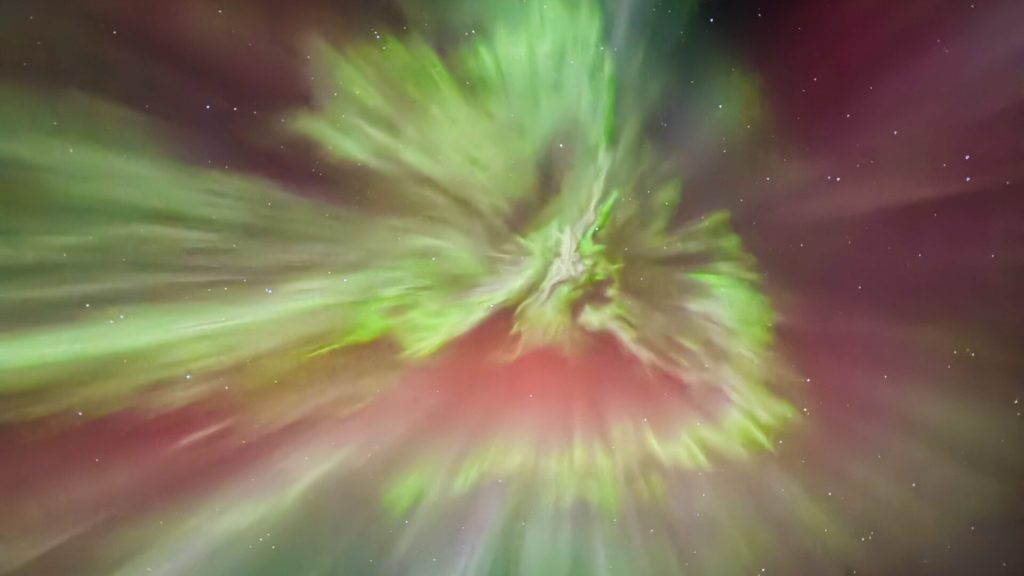
Oxygen produces green and red light, while nitrogen is associated with blue and pink shades. This is why a single auroral curtain can contain several colors at once. When different shades overlap, the light may also appear purple or almost white.
| Color | Gas producing the light | Approximate altitude |
| Green | Oxygen | About 100–200 km |
| Red | Oxygen | Above 200 km |
| Blue | Nitrogen | About 100–200 km |
| Pink | Nitrogen | About 100 km or lower |
The altitude ranges are based on NASA’s simplified classification. They are approximate rather than exact boundaries.
Common questions about what causes the northern lights
The northern lights usually form about 80–500 kilometers above the Earth’s surface. Much of the familiar green light is produced at an altitude of around 100–200 kilometers, while the red glow often forms higher up.
Yes, auroras occur on other planets as well. According to the European Space Agency (ESA), they have been observed on Mars and the giant planets Jupiter, Saturn, Uranus and Neptune. The basic process is similar to Earth’s: charged particles interact with a planet’s atmosphere and magnetic environment, producing light. However, auroras can look very different from one planet to another because their atmospheres and magnetic fields vary. Mars, for example, can produce auroras even though it lacks a global magnetic field.
(Source: European Space Agency, ”Mars Express discovers aurorae on Mars”)
Earth’s magnetic field guides the particles that produce auroras toward the regions around the magnetic poles. Ring-shaped zones called auroral ovals form in these areas. The auroras are therefore not centered directly over the geographic poles.
The position and width of the ovals change with magnetic activity. During a strong geomagnetic storm, they can expand toward the equator, allowing people in the Northern Hemisphere to see auroras much farther south than usual.
Would you like to see the northern lights for yourself? Join us on an aurora tour!
Lapland’s dark skies offer the best setting for viewing the northern lights. So join us on an aurora tour and enjoy Lapland’s natural landscapes with our local guides. The My Lapland Travel guides know the best places to watch the aurora and will take you away from the city lights in search of the northern lights. Along the way, you’ll experience Lapland’s winter landscape from a whole new perspective.
Sources
What are the northern lights? 12 fascinating facts explained
Best place to see aurora borealis – Where to go
How long do northern lights last – timing your aurora
When and where can you see the northern lights?